

Understanding the HPA Axis — and Why It Matters for Nervous System Regulation
The HPA axis (Hypothalamus–Pituitary–Adrenal axis) is one of the body’s primary systems for responding to stress. It’s a communication loop between the hypothalamus, the pituitary gland and the adrenal glands. Together, they coordinate how the body reacts to challenge — whether physical, emotional, or environmental.
The HPA axis (Hypothalamus–Pituitary–Adrenal axis) is one of the body’s primary systems for responding to stress.
It’s a communication loop between three key structures:
• The hypothalamus (in the brain)
• The pituitary gland (at the base of the brain)
• The adrenal glands (located on top of the kidneys)
Together, they coordinate how the body reacts to challenge — whether physical, emotional, or environmental.
How the HPA Axis Works
When something stressful occurs, the brain evaluates the situation through structures involved in threat detection and context.
The hypothalamus then signals the pituitary gland.
The pituitary sends a message to the adrenal glands.
The adrenal glands release hormones — including cortisol and adrenaline — which prepare the body to respond.
This is what allows us to mobilize energy, focus attention, and take action when needed.
In short bursts, this system is adaptive and protective.
When Stress Becomes Chronic
The difficulty arises when stress becomes ongoing.
Instead of activating and then returning to baseline, the HPA axis can remain engaged.
Over time, persistent activation may contribute to:
• elevated cortisol levels
• immune system disruption
• insomnia or sleep disruption
• inflammation
• mood and anxiety challenges
• metabolic imbalance
• cardiovascular strain
• changes in memory and cognitive function
Researchers are still learning about the long-term effects of HPA axis dysregulation, but it’s increasingly clear that chronic stress can influence both physical and emotional health.
A Nervous System–Hormone Connection
The HPA axis responds directly to signals from the nervous system.
The sympathetic nervous system (fight-flight-freeze) mobilizes us during stress. The parasympathetic nervous (rest-digest) system helps restore balance afterward.
When the nervous system has difficulty returning to regulation, the HPA axis may continue signaling the body to stay in a stress-ready state.
Supporting Regulation Through the Body
While lifestyle practices like sleep, nutrition, movement, and relaxation can help, the nervous system itself can be supported in sensing safety again, or for some, for the first time ever.
Somatic nervous system regulation works with the body’s internal feedback systems to shift patterns of chronic activation.
Through certain types of somatic practices like slow, attentive movement and working with a nervous system regulation-informed practitioner either hands-on or virtually, the nervous system can begin to:
• reduce persistent threat signaling
• support more balanced adrenal activity
• improve communication between brain and body
• encourage new neural pathways related to stability and recovery
Over time, this can help the HPA axis return to a more responsive — rather than constantly activated — state.
Because the HPA axis sits at the intersection of brain, hormones, and stress physiology, supporting nervous system regulation may also indirectly support:
• adrenal function
• pituitary signaling
• cortisol rhythm
• overall stress resilience
How to move forward
This is a central focus of the somatic regulation work I offer in person and will soon offer online — supporting the system in shifting from chronic activation toward greater adaptability and capacity.
Because this process involves developing new neural pathways to replace long-standing tension and neural patterns, change often takes some time and consistency. With regular practice, however, people tend to notice steady improvements in their daily functioning and overall physical well-being.

How Working with Your Body Can Calm Your Mind: A Somatic Approach to Anxiety and Stress
The body isn’t just the container for our stress—it’s also the pathway out. By learning to sense ourselves, move, and breathe with awareness, we can help our nervous system find its natural balance again. The result isn’t just relief from physical symptoms—it’s a deeper sense of safety and presence in our own skin.
When we think about stress and anxiety, we often think of them as mental or emotional problems. But the truth is, stress and anxiety lives in the body just as much as in the mind. The racing heart, the flushed face, the tight belly, the lump in the throat, the clenched jaw—these are all physical expressions of a nervous system on high alert.
High alert, also known as “fight, flight and freeze” states are often practiced tension patterns that are unconsciously held in the nervous system and body.
Somatic practices such as Feldenkrais®, Somatic Experiencing® (SE), and vagus nerve exercises work by engaging the body directly to help regulate the nervous system and bring these symptoms back into balance.
The Body’s “Bracing” Response
When we feel unsafe—physically or emotionally—our body naturally tightens or braces. This is a protective reflex, built into our nervous system. Over time, if stress or trauma is repeated or unresolved, this bracing pattern can become our “new normal.”
You might notice it most in one area—your shoulders, your jaw, your stomach—but it’s really a whole-body pattern. The muscles are held in subtle readiness, like a car engine idling too high. We may not even notice it until pain, tension, or exhaustion shows up.
This bracing is part of what keeps the nervous system “stuck” in a stress response. Even when the mind tries to relax, the body is still sending messages of tension and threat.
How Somatic Work Helps
Somatic methods invite the body to complete unfinished protective responses and return to a natural rhythm of tension and release.
In Somatic Experiencing, we slow down and track small sensations—tightness, fluttering, warmth, or softening—so the body can discharge survival energy bit by bit, rather than holding it.
In Feldenkrais, we use gentle, mindful movement to bring awareness to habitual patterns. As we learn to move in new, easier ways, the brain updates its sense of safety and control.
Vagus nerve exercises (like HeartMath® Coherence Breathing, Voo-ing, or grounding and orienting to the environment) directly engage the body’s “rest and digest” system, signaling safety and calm.
All of these approaches use the body’s own neurophysiology to shift our inner state. They don’t force relaxation—they invite regulation.
Rewiring How the Brain and Body Communicate
The nervous system learns through experience and repetition. When we bring awareness to how we hold ourselves—our resting muscle tone, our breathing, our posture—we begin to update old patterns in the brain.
This isn’t about “relaxing” in the usual sense; it’s about restoring natural mobility and ease . The body learns that it can mobilize when needed and also rest when it’s safe. Over time, this builds true resilience—the ability to move fluidly between activation and calm.
Tracking: The Practice of Noticing
A simple way to begin is by tracking—noticing what’s happening inside with a non-judgment non-corrective attitude:
Where do you feel effort or holding in your body right now?
Is your breath shallow, deep, or are you holding your breath?
Are your shoulders and arms squeezing in, or are you pressing your tongue into the roof of your mouth or the backs of your teeth?
These small observations tell the nervous system it can let go, that there’s no threat right now. Over time, this gentle awareness helps reduce symptoms like racing heart, heat in the body, or tension in the jaw and chest.
The Takeaway
The body isn’t just the container for our stress—it’s also the pathway out. By learning to sense ourselves, move, and breathe with awareness, we can help our nervous system find its natural balance again. The result isn’t just relief from physical symptoms—it’s a deeper sense of safety and presence in our own skin.
If the ideas in this blog post resonate with you and you’d like to learn more, there are several options. You can join one of the weekly live online Somatic classes — your first class is free. Or you can schedule a free initial consultation to talk about working 1:1 together. Support is available to fit every budget, schedule and location!
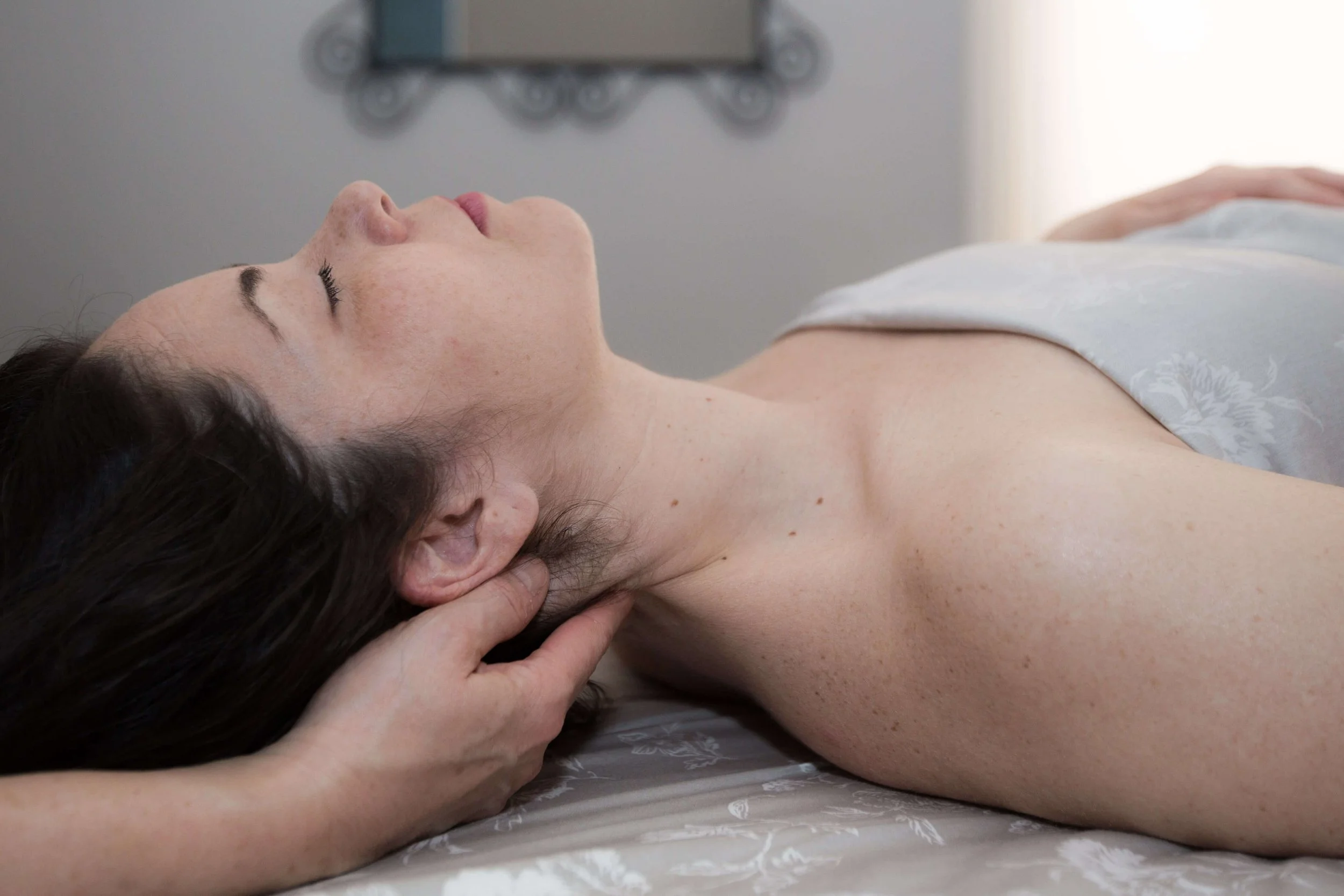
What to Expect in a Trauma-Informed Bodywork Session: How Touch Helps Heal Trauma and Regulate the Nervous System
When people ask me what trauma-informed bodywork looks like, I usually explain that it’s a gentle, hands-on approach that helps the body (and nervous system) find its way back to regulation and safety.
When people ask me what trauma-informed bodywork looks like, I usually explain that it’s a gentle, hands-on approach that helps the body (and nervous system) find its way back to regulation and safety.
Much of what I practice is inspired by the work of Kathy L. Kain, who integrates Ortho-Bionomy and somatic approaches, Dr. Peter Levine, the founder of Somatic Experiencing®, and Feldenkrais®, a method of somatic education. The basic idea is simple but profound: when the body feels regulated, our emotions and thoughts follow. We’re more grounded, less reactive, and better able to make healthy decisions.
What a Session Might Look Like
Sessions usually begin with a simple, supportive touch — for example, a steady contact at the small of your back while you remain fully clothed and comfortably lying on a treatment table.
This touch helps support the the adrenal glands, located just above the kidneys, and help regulate stress hormones like adrenaline and cortisol — key players in the body’s stress response. When these glands can “settle,” the body starts releasing long-held tension and stress hormones that may have been stuck in the system after prolonged periods of bracing or overwhelm.
When the adrenals are overworked, the body stays in a chronic fight-or-flight state. By helping them find balance, we remind the body how to access its parasympathetic response — the “rest and restore” mode — instead of constantly preparing for danger.
In practice, this might look like my hand resting quietly under your lower back for 10–15 minutes on one side, then the other. There’s no manipulation or movement — just gentle, steady contact that gives your system space to unwind at its own pace. I’ll often check in to see what you’re noticing, since this work is more of a collaborative process than something I do to you.
Deeper Layers of Regulation
Once your adrenal system begins to regulate over time (which can take several sessions depending on your history, nervous system and physiology), we can explore other forms of trauma-informed touch.
For example:
Brain stem holds can calm the nervous system and restore a sense of safety.
Fascia work helps release tension in the connective tissue just under the skin — a place where emotion and stress are often stored.
When fascia is tight or “activated,” it can contribute to feelings of agitation, anxiety, or even physical sensations like chest pressure or a creeping sense of fear. The mediastinum fascia, which wraps around the heart and lungs, is especially sensitive — calming this area can bring a deep sense of ease and spaciousness to the breath and chest.
Viscera work supports trauma healing by gently engaging the organs — where deep-seated “gut reactions” and stress responses often live. By helping the viscera release stored tension, this work can improve emotional regulation, support healthy organ function, and allow for a greater sense of presence and ease in the body.
Releasing Protective Patterns
Many of us live in bodies that are unconsciously bracing — jaw tight, shoulders rounded, chest tense, breath shallow. These are protective patterns that once helped us survive but now keep us stuck in chronic tension.
To support release, I often integrate movement-based approaches like the Feldenkrais Method® or Biodynamic Craniosacral Therapy. These gentle methods help the nervous system recognize safety through movement and awareness, softening patterns of holding and protection.
Feldenkrais helps your body unlearn old tension patterns that formed in response to stress or protection. As the nervous system discovers new options for movement, a natural sense of stability and calm begins to emerge.
Craniosacral Therapy uses light, attuned touch to help the body unwind from stress and trauma. From a trauma-informed lens, it helps the nervous system feel safe enough to release old patterns and return to a natural state of ease.
Why It Works
By working directly with the body, trauma-informed touch helps regulate the nervous system faster than talk alone. Once your body feels calmer and safer, talk therapy (if part of your process) becomes much more effective — because the body and mind are finally speaking the same language.

What is Medical Trauma: Why It Stays With You and What You Can Do
You’ve been through a medical procedure or intervention — either planned or unexpected. It’s over and you’re home. It’s been months or even years and you’re still feeling upset about how you were treated or about something that happened, but your rational mind is telling you “it’s over, let it go.” But you can’t.
You’ve been through a medical procedure—planned or unexpected. It’s over. You’re home. And yet, something still doesn’t feel resolved. Maybe it’s been weeks, months, or even years, and a part of you still feels upset, unsettled, or even disturbed by how you were treated or what happened.
Your logical mind says, “It’s done, just move on.”
But your body hasn’t.
This is a common experience with medical trauma—a kind of trauma that often goes unrecognized because the focus of someone’s experience is placed solely on the medical intervention and whether or not it was successful. But unresolved survival responses can stay lodged in the nervous system, creating persistent discomfort, anxiety, or disconnection.
What Does Medical Trauma Look Like?
Medical trauma doesn’t always stem from dramatic events. It can arise from subtle or seemingly “routine” experiences, such as:
Being dismissed or ignored by providers
Experiencing rudeness or coldness from staff
Not being believed about pain or symptoms
Waking suddenly from anesthesia without support
Hearing disturbing conversations while sedated
Feeling unsafe, unseen, or out of control
Lingering pain or sensitivity around a scar
Physical tension, anxiety, or tears that arise when recalling the event
Traumatic medical experiences do not only include trauma from medical procedures. PTSD from medical treatment can be caused by a mis-attuned medical care team as well. And when the body isn’t given space to process an experience, the survival energy can remain stuck—leading to physical symptoms, emotional distress, or a sense that something “isn’t right.”
How to Support Yourself during a medical intervention
There are two important phases where support can make a real difference: before and after a procedure.
1. Preparation Before a Procedure
From a Somatic Experiencing® perspective, preparation helps regulate the nervous system in advance—reducing overwhelm and building a sense of agency.
Here is a short list of steps I recommend to begin with:
Understand the procedure—only as much as feels supportive
Meet your provider as a whole, not just as a patient or “procedure”
Know what to expect before, during, and after
Express your concerns or ask questions ahead of time
Line up post-op support (meals, childcare, rides, etc.)
Learn how to recognize natural trauma releases as it moves through your body (shaking, crying, trembling are normal and healthy releases)
When the nervous system knows it’s safe, it can downshift from survival mode and allow for deeper healing.
2. Build in Grounding During the Procedure
Even small moments of presence and grounding during medical events can dramatically reduce trauma response. You can:
Let your care team know ahead of time that you'd like space for calming techniques
Use grounding tools like:
Deep, intentional breaths
A meaningful photo
A soft object or blanket
Calming music through headphones (if permitted)
These tools help signal safety to the nervous system, which can reduce overwhelm and help keep you anchored.
Aftercare: Somatic Healing for Medical Trauma
If trauma has already occurred, Somatic Experiencing® offers a powerful path forward. Instead of reliving the event through story or analysis, SE gently guides you to revisit the edges of the experience in a resourced, gentle, safe way. To learn more about how Somatic Experiencing® can help, click here.
This process, called titration, allows the body to slowly release survival energy that was never completed. Over time, your body and brain can update the story: “It’s over. I’m safe now.”
Healing Is Possible
Whether you’re preparing for a future procedure or carrying an unresolved experience from the past, there is a way through. With somatic tools and intentional support, you can move from holding trauma in your body to restoring a sense of calm, safety, and wholeness.

How to Map Your Own Nervous System
It’s helpful to be able to identify where you are on the nervous system “map,” so that you know what type of tools and exercises will be the most helpful to get to Ventral vagus state of connection and safety.
Dr. Stephen Porges is a neuroscientist and trauma expert who created a model to understand and work with the autonomic nervous system called the Polyvagal Theory.
Dr. Porges discovered that the autonomic nervous system (ANS) is organized in three “subsystems” and we naturally move between each state:
The Ventral Vagal system, which is the newest part of our nervous system, and is concerned with social connection and safety
The Sympathetic system, the sencond oldest part of our nervous system concerned with fighting and fleeing
And the Dorsal Vagal system, the oldest part of our nervous system and is concerned with survival and freezing or playing dead.
Vagus Nerve
Each of these subsystems is controlled by the vagus nerve, the 10th and longest cranial nerve in our body. The vagus nerve runs from the brainstem to the intestines and is sometimes referred to as the “brain in the gut.”
The vagus nerve is remarkable because it is both afferent and efferent. This means that the vagus nerve takes information from the brain to the organs of the body, and from the organs of the body back to the brain. So a feedback loop works to keep us safe and alive. When the body feels safe and relaxed, it sends a message through the vagus nerve to the brain that all is well and we experience a mental sense of calm and safety.
Calming ourselves is not dependent on exterior circumstances resolving — we can use our body to calm our brain and nervous system. This is called a “bottom up” approach. Therapy and using the mind to calm us is a “top down” approach.
When our nervous system is overwhelmed, we can stay in either Sympathetic (fight or flight) or Dorsal Vagal (freeze and dissociation) or ping pong between the two states. Many of us live between these two states or in freeze with sudden surges of adrenaline. We call this having one foot on the brake and the other on the gas pedal.
It’s possible to gradually move more into the state of connection and safety, but it’s important to understand where we are on the Polyvagal “Map” so that we can utilize the most effective nervous system regulating techniques to move us in the appropriate direction from where we are at the moment.
In other words, the question is not only how to regulate nervous system physiology, but where are you currently on the spectrum so that you know which tools will be most effective.
Here’s a summary of the three states so you can identify where you are on the nervous system “map.”
Ventral Vagal
The ventral side of the vagus nerve responds to cues of safety and interactions in our environment. It supports feelings of physical safety and safe emotional connection to others in our social environment. It’s associated with feeling connected with others. This is the newest addition to the nervous system and when we’re in our ventral vagal nervous system, we feel grounded, safe, calm , connected and engaged. It’s a good place to make decisions from.
Ventral Vagal = Safe + Social
Communicates well
Resourced
Present
Connected + warm
Curious
Grounded
At ease
A good place from which to make decisions
Ready to learn
Physical:
Increased digestion, immune response, rest, oxytocin, breathing freely
Dorsal Vagal
The dorsal side of the vagus nerve responds to cues of danger. It pulls us away from connection, and into a state of self-protection and dissociation. In moments when we might experience a cue of extreme danger, we can shut down and feel frozen, an indication that our dorsal vagal nerve has taken over. It’s associated with being immobilized. When we’re in fear or we can’t call for help, fight or flee, our nervous system is overwhelmed, we shut down and get numb.
Dorsal Vagal = Immobilized + Freeze
Shutdown
Trapped
Disconnected
Numb
Hopeless
Helpless
Shame
Despair
Depressed
Emotions shut down
Dissociated
Physical:
Feels like a zombie, hard to get out of bed or off the sofa
Decreased eye contact, awareness, social behavior, libido, heart rate slows
Increased pain threshold, endorphins that numb pain
Sympathetic
The Sympathetic nervous system is associated with fight and flight. In this reponse, we mobilize in the face of a cue of danger. We spring into action with our adrenaline rush to get away or to fight off our threat. Often we stay in this part of our nervous system much longer than we need.
Sympathetic = Mobilized for Fight + Flight
Rage
Anger
Frustration
Irritation
Confrontational
Panic
Chronic stress
Anxiety
Jumpy
Worry
Hard to think
Impulsive
Ready to run
Easily activated, startled
Senses are on alert
Physical:
Increased heart rate, adrenaline, faster or restricted breathing
Decreased ability to relate to others, digestion
A Paradox
The important thing to know is that when we’re in Sympathetic, we can use calming techniques or exercises to bring us back into Ventral vagal. But inorder to return to Ventral vagal from Dorsal vagal (freeze) state, we need to go through the Sympathetic state... but this is more nuanced than it sounds.
Because freeze state is essentially immobilization, we need to gently and slowly mobilize in order to find safety and connection. We cannot get to safety by doing calming exercises. At first this seems like a paradox.
But if you think about when a hibernating bear wakes up, there’s a lot of immobilization energy to jump start, and it can’t happen quickly. At first Mr. Bear will move his arms and legs, then he’ll scratch and stretch, then he’ll groom himself. (Yes, I did research how a bear comes out of hibrernation for this article). He’ll be a bit groggy and he’ll move slowly as he emerges from his den. He doesn’t jump right into socializing, nor does he jump into action. He has a transition period which includes slow, gentle mobilizing.
Coming out of a freeze or dissociated state is much like a hibernating bear waking up.
Rather than jumping up quickly or doing something super calming, our nervous system requires some very slow, gentle movement. This actually mobililzes us and we’re able to enter into a Ventral vagal state of safety and connection more naturally.
Unfortunately many well-intentioned nervous system regulation advice on social media doesn’t understand this about freeze state and suggests calming exercises for freeze state or overly activating exercises (for example, activating breathwork) for either state that doesn’t serve any purpose.
Therefore, the more you understand about where you are on the map and what you need to regulate, the better.
Your next step…
It’s helpful to be able to identify where you are on the nervous system “map,” so that you know what type of tools will be the most helpful to get to Ventral vagus state.
Once you have a clear sense of where you are on the Polyvagal map, and a clear sense of where you need to go to regulate, your next step is to find techniques and exercises that you enjoy and relate to that you’re willing to commit to practicing regularly (daily) to begin creating new neural patterns.

Somatic Exercises to Take You From Freeze State to Safety and Connection
When working within the Polyvagal nervous system regulation framework, we know that in order to bring someone out of a freeze and dissociated state, we need to gently mobilize their nervous system within their capacity. Here are some effective somatic exercises for working with the freeze state.
When working within the Polyvagal nervous system regulation framework, we know that in order to bring someone out of a freeze and dissociated state, we need to gently mobilize their nervous system within their capacity.
We don’t want to overstimulate or overwhelm their system, but we want their system to experience a little bit of activation within their capacity. It’s in this way that their system will begin to experience expansion and their window of tolerance — what they can tolerate without moving into fight or flight — will grow. The key is to to know how to regulate nervous system physiology, which can include either knowing how to calm your nervous system or how to gently stimulate it— depending on what you need.
Where you are on the nervous system “map” will determine which somatic exercises may be the most effective for you
In How to map your own nervous system, we discussed the three different subsystems of the Polyvagal system: Ventral vagal which is the state of connection and safety, the Sympathetic system, which is the state of fight and flight or mobilization, and the Dorsal Vagal system, which is the state of freeze and immobilization.
Many people are stuck in the Freeze state or what we call “functional freeze,” where they are able to function or even excel in their jobs, but feel numb and unfulfilled, self isolate, and feel like they’re in a fog when at home.
Others find themselves ping ponging between flight and flight state and freeze states. Often this looks like feeling exhausted and dissociated (detached from their bodies) but easily startled by sounds or activated by anything even remotely stressful and then they plunge back into freeze. In the Polyvagal world, this is called having one foot on the brake and one foot on the gas, and it’s exhausting to live like this.
Somatic exercises for freeze state
These Somatic exercises are some of my favorite practices to help you gently mobilize while staying well within your capacity. Try one or all of them and see whether any of them shift you .01%. You’re not looking for a huge shift — you want a tiny subtle shift. Then, you practice it every day. I know, that’s the hard part, but think of it as training your nervous system — creating new neural pathways… new neural habits, a tiny bit at a time. After 3 weeks, see what you notice.
This is my favorite somatic exercise for gently mobilizing when in a dissociated or freeze state. Often, when we’ve been immobilized, we also feel stiff because we haven’t been moving, so this addresses both the physical mobility as well as moving energy stuck in the joints.
When in freeze state, some people feel exhausted and can barely get out of bed or off the sofa, but as tired as they feel, they can’t sleep either. If you can relate to this, try doing this while lying in bed. Some people report falling asleep while listening to the audio. Doing only a few of the movements regulates them enough that their sleep improves. Think about it this way, when we feel safe, our bodies will do what they naturally need to do. Sometimes, the most important thing is to sleep deeply.
For this exercise, Moving the Joints, I’m sending you to my Insight Timer account for a free guided audio recording. You may need to download Insight Timer on your phone or go to insighttimer.com to set up a free account and then click on this link.
Click on this link for Moving your Joints audio recording.
Please follow me on Insight Timer for access to other free audio recordings.
Squeezing your arms and legs
This exercise is especially helpful if you feel dissociated in your limbs. It helps bring awareness back into your limbs. Begin by squeezing your upper arms, from your shoulder to your elbow and from your elbow to your wrist. Then do the same for your thighs and then lower legs.
Anchoring your container
Our hands take up 35% of the real estate in the sensorsy part of your brain. This means that your hands are influential when bringing attention and awareness to different parts of your body.
Often when we’re in freeze or dissociated state, we aren’t connected to parts of ourselves. We don’t feel our lower body or limbs.
What we’re doing in this exercise is using our hands to bring awareness to the parts of ourselves that feels disembodied and drawing the energy downwards in to our feet on the ground.
Exercise:
Begin by having your feet flat on the floor or ground. Wiggle your toes and feel the connection with your feet and toes. Then, place your hands on your upper body or lower body — wherever you feel disembodied — and begin to stroke downwards. You can do this on your head and face, arms, torso, hips, and then really focus your attention on your legs, knees, lower legs and feet. You continuously stroke downwards towards your feet and the floor. Spend extra time stroking your feet and heels, feeling the connection to the ground.
Orienting + grounding exercise
This is one of the most important exercises you can do daily. You’ll practice feeling your body on your chair or bed as well as looking around the room and orienting. Animals in the wild do this exercise naturally to let themselves know they’re safe. Babies orient constantly. When we practice these innate nervous system exercises, our brain recognizes these as familiar and signals to our brain and body that we’re safe.
Download Insight Timer free app or go on Insighttimer.com and click on the link below for a free 7-minute audio recording.
Click on this link for “Orienting + Grounding.”
Voo
This is an effective Somatic Experiencing® exercise that gently stimulates the vagus nerve by vibrating all of the organs.
When we’re in freeze, our body signals the brain that it’s not safe. Then the body operates at a low level and conserves energy. But when we Voo, we create a gentle vibration throughout the entire system and the vagus nerve connects all the internal organs and signals to the brain that the body (including the lungs, heart, organs, and digestive system) is safe, and the body slowly mobilizes.
Exercise:
To practice Voo, sit comfortably. Because the vagus nerve innervates both sides of your face and neck, you can place one of both hands on the sides of your neck so you can feel the vibration.
Take a deep breath in, and as you exhale, make a low, deep sound of “Voo.” Think of the Voo sound being like the low deep sound of a fog horn on the water at night.
When you complete your Voo, sit for a moment and feel yourself.
Then repeat once again. Only do this 2-3 times as it’s sneaky powerful and you don’t want to overdo it.
Sit with yourself for a few moments. Some people may observe some physical sensations, notice some images, emotions, or feel a little activated. If it feels like too much, do less next time. Our goal is to gently mobilize, so it’s okay to be a tiny bit activated as long as it feels completely tolerable and doesn’t put you in fight or flight. This builds capacity in your nervous system.
Remember that the nervous system is super sensitive and processes more slowly than your rational, thinking brain does. So don’t overthink or overanalyze or over judge what’s happening. You’re in new territory!

Trauma Informed Bodywork and Somatic Experiencing® for Narcissistic Abuse
The Feldenkrais Method® and Somatic Experiencing® are two robust somatic methods that help release chronic muscle tension and regulate the nervous system. One tool helped me learn to sense and feel safety in my body and to trust my own inner guidance again, while the other tool helped me release the powerful thwarted energy that got stuck in my body, causing me chronic pain and fatigue.
A study published in the Journal of Social and Personal Relationships reports that about 25% of individuals have experienced some form of narcissistic abuse in their relationships.
From 2012-2017 I myself was in a narcissistic abusive relationship.
I recognize that the term “narcissist” is a buzz word these days, but I’ve had several licensed clinicians confirm that this person was someone with textbook NPD, Narcissist Personality Disorder. Anyone who’s experienced this, is unfortunately very familiar with the signs, symptoms and predictable cycles.
Even if a person is able to leave a traumatic situation of this type, they are often left with emotional and physical symptoms that don’t simply “go away” or fade over time.
One of the characteristics of a narcissistic abusive relationship is that it’s insidious. This means the cues of danger may not be present at the onset and they develop gradually without being noticed.
In other words, narcissistic abuse often starts slowly and gradually worsens over time.
Relationships of this type usually begins with “love-bombing," a phase where the abuser initially seems loving, generous and supportive. It can be so intense that the victim feel the abuser is too good to be true, “the love of their life.” Then, the abuser slowly begins to use manipulative tactics, such as gaslighting and belittling, silent treatment, passive aggression, and triangulation, to undermine the victim's self-worth and confidence. This is intermingled with intermittent acts of kindness so the victim becomes confused about which version of their abuser is real. As time goes on, the abuser adds in verbal abuse and sometimes physical abuse.
The aftermath
In my own case, the experience left me with severe and long-lasting effects on my physical and mental health including PTSD.
I went to therapy regularly for a number of years and found that talking about what I had experienced only made my physical symptoms of anxiety and my depression worsen. I tried EMDR and it didn’t really help me, although I know it helps some people and it’s recognized as “evidence based” by the American Psychiatric Association.
For me, what began to change my physiology and regulate my nervous system was trauma-informed somatic work.
Note: If you are more comfortable staying with traditional, medical evidence-based psychotherapeutic techniques like CBT, then what I’m about to share may not resonate with you and that’s okay. It’s up to each individual to choose what methods make the most sense to them. If you’re in the midst of a narcissistic abusive relationship, it makes sense to stay with your therapist and add in somatic work once you’ve left the situation and are safe. In writing about this, my goal is to share some lesser-known alternatives to traditional psychotherapy or medication that worked for me and for many others.
Common physical symptoms of anxiety and hypervigilance include:
Digestive issues, nausea
Not being able to eat or overeating
Chronic neck, shoulder and back pain
Physiology of “bracing” or “contracing”
Jaw pain
Joint pain, sciatica
Shallow breathing or not being able to take a deep breath
Headaches and migraines
Racing heart
Sweaty palms
Face heating up suddenly
Migraines, headaches
Trembling, shaking, twitching, buzzing
Insomnia
Chronic fatigue
Some emotional symptoms—that are not always talked about—may include:
Feeling like you’ve always done something wrong
Feeling confused about what’s really true (cognitive dissonance)
You don’t recognize yourself, feeling lost and empty
Feeling isolated
Shame and hiding what you’re experiencing from others
Feeling anxious or depressed or hopeless
Trouble setting boundaries
Are ready to forgive and forget at the first sign of kindness
Loss of self trust; disconnected from your own intuition
A feeling of overwhelm (or freeze)
Feeling like you’ll die if you leave them (trauma bonding)
Hypervigilant - “Walking on eggshells” like you’re constantly waiting for the next attack
Two effective Somatic Tools: The Feldenkrais Method® and Somatic Experiencing®
In the case of narcissistic abuse, we feel we’re “under attack” 24/7 — unless, of course, the abuser senses they’ve gone too far and then they are attentive and loving as they were in the beginning of the relationship. When this happens and they show signs of the person we first met, we wonder why we felt so anxious and we wipe the slate clean, only to go through another cycle of abuse.
We’re stuck in a state of hypervigilance and confusion and it takes its toll on our brain, nervous system and body.
Feldenkrais is a gentle, non-invasive way to reconnect to your body so that you can sense, feel and trust yourself.
The Feldenkrais Method®, a robust somatic method that helps release chronic muscle tension and regulate the nervous system, was the first tool I used in order to learn to trust my own inner guidance again.
Amidst the chaos in my daily life during the abuse, this somatic work allowed me to reconnect to my body and listen. I was able to feel those physical cues of danger. For example, when I felt my stomach tense, I knew my body was telling me to listen. When I felt my chest or throat constrict, I was able to trust myself vs being confused. I began to be less dissociated or out of my body and to feel a sense of safety and grounding that I hadn’t felt before.
Before I was constantly scanning my environment and his face for cues of danger because I was dissociated. But now, I could feel my body give me cues and I knew I could trust it.
Feldenkrais is also an effective way for someone to learn to self regulate. During narcissistic abuse, it wasn’t safe to “relax” deeply. The constant threat of being under attack was always present. This method allows muscle tension to release effortlessly, and muscle tension = emotional tension.
This method— whether working 1:1 with a practitioner or taking group classes — allows a person to:
Unwind habits of stress and overstimulation
Regulate breathing
Relax muscles and ease joint pain
Respond vs reacting
Calm the mind and emotions
Feel grounded
Improve sleep
Feel a sense of safety, well being or neutral
Somatic Experiencing® (SE) is another somatic method that helps a person complete threat response cycles.
For example, when I felt the desire to fight back or speak up about the abusive treatment I was receiving, but I remained silent because I was afraid of the consequences, that powerful “fight” energy got stuck in my body. It had no where to go but inward.
Or when I felt the deserate desire to get away, but couldn’t leave — again, that energy was thwarted, and stayed lodged in the physical tissues of my body: in my muscles, joints, gut, jaw, etc.
This is common in any traumatic situation. But with narcissistic abuse, it’s especially relentless and continuous, and takes a significant toll on a person’s mind and body.
Some time after I finally left the relationship, I found myself with sciatica and plantar fasciitis, and chronic fatigue, but it made no rational sense. Now I know that was stuck energy. With Feldenkrais and SE, that chronic pain and fatigue has dissipated. I’m gradually increasing my energy and health.
Next Steps
As a client and practitioner of both of these robust somatic methods, and several others, I have found that the somatic option for releasing trauma from the body is far more effective than talking about the experience.
If you or someone you know has experienced narcissistic abuse, you may consider trauma-informed somatic work to help you on your healing journey.
Please allow me to support you in this process. If you’d like to talk in person, please schedule a free 15 minute consultation to see if working together is a good fit for you. We can work in person in San Diego or online. Schedule here or email me and I’ll get right back to you.

Physical Symptoms of Anxiety and Hyper-Vigilance
From a somatic, or body perspective, anxiety refers to the sensations generated by the body’s total response to a threat. Our body reacts to this threat because it will do anything to survive. When we remain in a constant state of hypervigilance, we experience predictable bracing and contracting patterns throughout our system.
From a somatic, or body perspective, anxiety refers to the “sensations generated by the body’s total response to a threat.” The body reacts to this threat because it will do anything to survive.
Physiological symptoms of anxiety and being in a hypervigilant state include:
Chronic muscle pain (back, neck, shoulders, hips, pelvis, etc.)
Heart palpitations or irregular heart beat
Holding breath, shallow breathing or shortness of breath
Migraines and headaches
Contraction in throat, chest, belly
Digestive issues (constipation or loose bowels diarrhea, etc.)
Sleep issues, insomnia
Fibromyalgia
Sweating, especially palms of hands or soles of feet
Heat or shivering
Dizziness, light-headedness
Pins and needles
Trembling, shaking, twitching
Feeling weak or tired
A churning feeling in your stomach
Nauseau
Feeling restless or irritable
Difficulty concentrating
Grinding teeth or pressing tongue into backs of teeth
Do any of these physical symptoms sound familiar? If so, the good news is it’s not a bunch of different problems — it’s all one thing: a dys-regulated nervous system, very possibly like this for many years, and possibly your body’s way of managing a fight or flight charge that was never released at the time of one or many traumatic events — either recent or from many years ago.
THE AMYGDALA’S ROLE IN ANXIETY
Some people find psychotherapy helpful, but often people report there’s no real change in their physical symptoms of anxiety from talking — also referred to as a “top-down” approach.
One reason for the inability to feel physical relief is that the amygdala, the part of the brain that is scanning for danger because it’s wired for us to survive, continues to fire and send signals to the body to be vigilant. So the body continues to “brace” and “contract” in anticipation for the next bad thing to happen. The rational thinking part of the brain can’t come online until the more primitive, survival part of the brain calms down.
The amygdala doesn’t listen to reason, it acts to keep you safe.
When the amygdala, the part of the limbic system that protects us, perceives a threat, it triggers a fear or anxiety response that activates the body's fight-or-flight system. This response can include increased heart rate and blood pressure, feelings of fear and anxiety, and increased stress hormone levels, and any of the symptoms listed above.
We can’t control our physiology with the thinking (rational) part of our brain. We can’t reason ourselves out of a burst of cortisol or rapid heart rate.
But we can use the sensory part of our brain to regulate our physiology.
BOTTOM UP APPROACHES TO REGULATE THE NERVOUS SYSTEM AND REDUCE PHYSICAL SYMPTOMS OF ANXIETY
This is where “bottom up” approaches such as trauma-informed somatic techniques and trauma-informed bodywork are effective in changing the physiology of anxiety and regulating the nervous system.
Some of these techniques include: Somatic Experiencing®, The Feldenkrais Method®, Havening Technique®, and Craniosacral therapy.
The goal is not only to simply feel calmer for the moment and then fall back into anxiety, but to learn how to regulate nervous system physiology and create new, healthier neural pathways (also known as neural “habits”) that begin to overtake the older, habitual neural pathways of anxiety.
Neural pathways are simply the connections that form between the neurons, or brain cells, in your brain.
Somatic Experiencing® and Feldenkrais® work with the process of neuroplasticity. Neuroplasticity is the ability of the brain to change and reorganize and to create new neuralpathways.
With these somatic methods, you actually change nervous system “habits,” but instead of doing this from the top down (i.e., mind over matter or forcing oneself to be or think a certain way) it’s done with a bottom up approach, which means including one’s body in the equation and following and listening with one’s focused attention to the sensations of the body to guide the process.
Movement as a common pathway in the body
Feldenkrais uses focused attention and slow, gentle, small movements to access this inherent plasticity of the brain.
Movement is the common pathway to all of our body systems: respiratory system, nervous system, muscular system, cardiovascular system, digestive system, urinary system, endocrine system, lymphatic system.
Our nervous system keeps us safe by knowing when to move toward, move away from, stay still to conserve energy, and so on.
The nervous system processes as a very slow pace. In Feldenkrais, we move slowly to match the pace of the nervous system. We make small movements to create a non-threatening environment for the brain so that it can signal muscles to release.
To read more about how Feldenkrais works with neuralplasticity, link here.
The reason for the nervous system is movement.
Fast movements heighten the sympathetic activity (fight and flight) and slow movements allow the nervous system to be in a parasympathetic state (rest and digest).
In Feldenkrais we move slowly to allow the brain to access this parasympathetic state.
When you’re in chronic pain or experiencing other physical symptoms of anxiety, your thinking brain is off line and the brain is noisy. The brain believes there’s a threat that’s emminent.
Feldenkrais provide alternatives to what has been the status quo of anxiety.
When working within the framework of Somatic Experiencing®, this trauma informed bodywork can create an experience of safety, grounding and resourcing so that people can begin to work with the unprocessed trauma through the wisdom of their body.

How does Somatic Experiencing® Work?
Working with the body is key to allowing the activated charge, that has been trapped in the physical body since the traumatic event, to dissipate or dissolve, especially when the physical symptoms of that traumatic event show up months or years later as chronic physical pain and physiological symptoms of stress and anxiety.
Dr. Gabor Mate describes “trauma” as “…not WHAT happens to you, but what happens INSIDE you as a result of what happens to you.”
Until recently, we humans have collectively believed that in order to find relief from past trauma:
1. we need to let go of what happened in the past and allow it to stay in the past because “time heals everything.”
Or…
2. we need to talk about what happened and work with the story. If we can only understand what happened on a rational, logical level, and mentally understand how to look at it differently, we will eventually not be so affected by it.
Or…
3. We need to have a cathartic “release” from our past trauma — a big dramatic, sometimes painful series of moments where the pain then disappears forever. This might happen with crying, deep breathwork, immersive therapy where the environment mimicking what your trauma was like is recreated, or other intense methods.
I have personally experienced several of the above techniques during phsychotherapy for years and none of it moved me forward in a significant way. Most of the methods involved talking about or reliving the events, which left me feeling drained and even more emotionally activated than when I arrived at the therapist’s office.
Using the Somatic Experiencing® method
There is a different, effective, gentler, and less emotionally-taxing way to work with trauma called Somatic Experiencing®.
Somatic Experiencing® or SE, works somatically, or with the body and brain together to gradually allow the activated charge, that has been trapped in the physical body since the event, dissipate or dissolve.
The significance of the body when working with trauma is key to releasing the grip of trauma, even when the physical symptoms of that traumatic event show up months or years later as chronic physical pain and physiological symptoms of stress and anxiety. (For more information about how to recognize the physical symptoms of anxiety and hypervigilance, read this blog post.)
The SE® method is slow, gentle, and titrated (which means we work little by little, based on the current capacity of the person’s nervous system). We bring the focus of the session into the person’s body, where the thwarted energy of the traumatic experience is stored and present.
Who benefits from Somatic Experiencing®?
SE® is designed to be effective for people who have experienced the following types of traumatic events:
Auto accidents
Physical injuries, including sposts injuries
Relational injury (and attachment trauma)
Emotional abuse, including narcissistic abuse
Physical abuse
Sexual abuse
PTSD
CPTSD (childhood)
Someone who wants to learn how to regulate nervous system physiology
“Startle” and “Protect” physiological patterns
When someone has experienced a traumatic event, or ongoing events as in childhood, or relational abuse, a person’s physiology can stay in a “startle” pattern which includes bracing throughout the system or a “protect” pattern which includes contractions throughout the system.
A person might be aware that they, for example, clench their teeth or hands, or hold their breath. Or they might round their shoulders forwards and they may feel constriction in their throat or chest and tightness in their belly. Sometimes they have chronic digestive issues—either constipation or extremely loose bowels. Or they have back, neck or shoulder pain. These muscular habits of hypervigilance show up throughout their entire physiology— but they may just feel it as “normal” for them. But all of this can be part of the same nervous system pattern.
Seemingly normal habits like nail biting or constant foot swinging or tapping is the nervous system’s attempt to self soothe and self regulte. Usually there is deeper physical “holding” on the musculoskeletal level throughout the person’s system.
This method works with people who experience musculoskeletal patterns of anxiety and hypervigilance, or bracing and contracting.
For more information on how these physiological patterns show up in the body, link here.
How we work with the body to release trauma
If someone has had an auto accident, they likely hold muscle tension patterns from the experience. In such an experience we often have powerful energy build up. Our nervous system naturally gathers all it’s power and looks for ways to flee or engage in fighting against impact. That powerful energy surge is thwarted and becomes stuck in the joints or muscles. This is a common cause for neck pain or things like frozen shoulder, on top of any physical injury that ocurred.
In SE® we begin a slow process to revisit the experience from within the sensations of the physical body — beginning with resourcing the client until it’s clear they have the capacity to touch into the different pieces of the event. We work with nervous system regulation techniques so that they aren’t re-traumatized as we approach significant moments that make up the event.
The nervous system processes at a very…very… slow… pace. So we go very, very slowly—at a pace that the sensory part of the brain can accommodate, and so that the brain can re-experience small pieces of the event. And this time, re-exepriencing it in resourced, manageable way, the body is successful in finally moving that stuck, thwarted energy, either through physical movement or doing something differently and in a more resourced conscious way in the imagination.
Because our brain doesn’t know the difference between what actually happened in the past and our imagination in the present, it can reprocess this information sensorily and muscles can finally relax and let go permanently.
Discharge of energy
Often clients will have the discharge that their body’s didn’t get the chance to have the first time around. Discharge can include crying for no apparent reason, shaking, shivering, trembling, yawning, or deep sighs. This discharge is what animals are able to experience naturally in the wild after a big chase. They move this powerful fight-flight energy through their bodies vs storing it as anxiety. You rarely hear about a stressed out tiger!
Some events take a number of sessions to let go of that thwarted muscle energy, as in cases that have multiple dimensions to them like childhood abuse or mistreatment. One-off events can take less time, but it depends on each situation, each person and each practitioner.
A growing number of psychotherapists have SE® training, but because they’re bound by their license not to use touch, they often resort to a more talk therapy approach. If you like the idea of trauma-informed bodywork done through the lens of a trauma-informed framework, then finding an SEP (Somatic Experiencing® Practitioner) who can integrate the SE® with robust somatic hands-on bodywork may be a good choice. There’s no right way — only the way that feels right to each individual person.

What is Somatic Experiencing®?
Somatic Experiencing® is a body first approach to dealing with the problematic (and oftentimes physical) symptoms of trauma. It helps individuals create new experiences in their bodies; ones that contradict those of tension and overwhelming helplessness.
Somatic Experiencing® (SE) is a body-based method that helps people process trauma and other symptoms of stress, shock, and anxiety.
SE® is based on the idea that healing the physical experience of trauma (as it’s felt in the body) can also heal the emotional experience.
WHAT IS TRAUMA?
Peter Levine is an author, teacher and the creator of the Gold Standard of trauma therapies, Somatic Experiencing® (SE).
Dr. Levine says that trauma may begin as acute stress from a perceived life-threat or as the end product of cumulative stress. Both types of stress can impair a person’s ability to function with resilience and ease and live in the present moment.
Trauma may result from a wide variety of stressors such as accidents, invasive medical procedures, sexual or physical assault, emotional abuse, neglect, war, oppression, natural disasters, loss, birth trauma, epigenetics, systems, or the corrosive stressors of ongoing fear and conflict, and chronic shaming.
Years ago, trauma was defined more by external events rather than the responses human beings have to those events.
Today, it’s understood that “trauma is not WHAT happens to you, but what happens inside you as a result of what happens to you,” according to Dr. Gabor Mate
.
COMPLETING FIGHT, FLIGHT AND FREEZE RESPONSES
According to Dr. Levine, trauma can happen to anyone when they perceive a situation as a threat and are unable to complete a satisfactory fight, flight or freeze response.
Our nervous system is designed to keep us psychologically intact when we perceive we cannot keep ourselves safe in a situation. However, if we do not address the way in which our nervous system and memory categorized the event, it can take a toll on us emotionally, mentally, and physically over the years.
Dr. Levine was inspired to study stress on the nervous system when he realized that animals in the wild are constantly under threat of death from predators, yet they rarely show symptoms of trauma.
He discovered that deep trauma has to do with the third survival response to perceived life threat, which is freeze and collapse. When fight and flight are not options, both animals in the wild and humans freeze and immobilize, like “playing dead.” Its actually a brilliant system at that moment because it makes us less of a target.
However, this freeze reaction is designed to be time-sensitive, in other words, it needs to run its course, and the massive energy that was prepared for fight or flight needs to get discharged through shakes and trembling. If the immobility/freeze phase isn’t completed, that charge stays trapped in the tissues of the body, and, from the body’s perspective, the body is still under threat.
SOMATIC EXPERIENCING® IS A BODY-BASED APPROACH TO HEALING TRAUMA
The Somatic Experiencing® method works to release this stored energy and turn off this threat alarm that causes dysregulation and dissociation to the nervous system. SE® helps people understand this body response to trauma and work through a “body first” approach to healing. Within their scope of practice, SE Practitioners work with these responses in a way that supports their clients. You can learn more about how Somatic Experiencing works here.
Like, Dr. Gabor Mate, Dr. Levine believes that the traumatic event isn’t what causes long-lasting trauma, it is the overwhelming trapped response to the perceived life-threat that is causing an imbalanced nervous system.
Somatic Experiencing’s aim is to help one access the body memory (procedural memory) of the event, not the story. In SE, we focus less on the narrative of the story. The objective is to diffuse the power of the narrative and remap the body memory to regain aliveness and flow.
Somatic Experiencing® is a body first approach to dealing with the problematic (and oftentimes physical) symptoms of trauma. It helps individuals create new experiences in their bodies; ones that contradict those of tension and overwhelming helplessness. This means that healing isn’t about reclaiming memories or changing our thoughts and beliefs about how we feel, it’s about exploring the sensations that lie underneath our feelings and beliefs, as well as our habitual behavior patterns.
Resources:
https://traumahealing.org/

Calm Your Stress with These 4 Powerful Breathing Techniques
Did you know that slowing your breathing helps you calm down, and that taking a few minutes to do breathing exercises can help relax your mind and body, making it easier to cope with stress and anxiety?
Did you know that slowing your breathing helps you calm down, and that taking a few minutes to do breathing exercises can help relax your mind and body, making it easier to cope with stress and anxiety?
In fact, it’s almost futile to try to put mindset or focusing techniques into practice when your nervous system is dysregulated. It’s like putting whip cream on poop and expecting it to taste good — pardon the metaphor! Basically, you just cannot ignore or override a dysregulated nervous system! (To learn more about your nervous system, click here.)
It’s scientifically proven that breathing not only helps us calm down in a moment when we’re activated, but also makes it easier to access and use what we’ve learned.
For example, if you have a presentation or exam coming up, doing one of these breathing techniques will help you think and access the information more clearly. (To learn more about the physical symptoms of stress and anxiety, click here.)
We also know that continued shallow breathing can actually do the opposite, keeping our bodies in a cycle of stress and affecting everything from our mental to physical health. When we are stressed, we tend to close down in a number of ways and, while this can feel protective, it often deprives us of needed emotional, cognitive and physical resources. It can even make us more likely to get sick.
Here are four simple breathing exercises you can do to relieve stress anywhere and anytime. Try using them daily, whether you are clearly feeling stressed or not. If you practice them as a maintenance practice, it will be easier and more efficient for your body to acclimate right away. You can also use any of these breathing techniques whenever you feel impatient or frustrated (like waiting in line), or in moments when you feel uptight, overwhelmed, stressed, or anxious. For more information about what “self care” means, click here.”
Box Breathing
This exercise is a classic. You can do it while sitting or lying down.
1. Exhale all the air from your lungs while counting to four.
2. Hold for a count of four, keeping your lungs completely empty.
3. Inhale a deep, full breath for a count of four.
4. Keep your lungs full for a count of four.
Repeat for at least 4 rounds but reduce or rest if you feel light-headed.
4-2-6-2 Breathing
This is as an effective way to calm the sympathetic (fight + flight) nervous system response and activate your parasympathetic (rest + digest) nervous system when you feel activated or stressed. Sometimes I do this one when I’m with people who I feel tension around and and they don’t even know I’m doing it. It really helps!
1. Breathe in for a count of 4
2. Hold for a count of 2
3. Breathe out for a count of 6
4. Hold for a count of 2
Repeat 5X.
Next,
1. Breathe in for a count of 4
2. Hold for a count of 2
3. Breathe out for a count of 8
4. Hold for a count of 2
Repeat 5X.
You’ll find it becomes easy to keep adding 2 counts to each exhale after 5 repetitions of each set.
Relaxing NADA Yoga Breathing
Sit in a comfortable position. Your eyes can be open or closed.
1. Close your mouth and inhale through your nose for 4 counts.
2. Hold your breath for 2 counts.
3. With your mouth closed, “Hummmmm” for as long as it takes you to empty your lungs. This makes a buzzing sound that sounds like a bee. This will vibrate in your chest, throat and head.
4. Hold for 2 counts, and repeat steps 1-3 six times.
Falling Out Breath
I actually found this one on the Noom app and really like it for helping to release physical tension from my body.
1. Take a deep breath in, filling your lungs as much as possible.
2. At the top of your breath, take one more sip of air.
3. Exhale with a big, out-loud sigh (“HHHAAAAA”) as you release the air.
Do this for 1-2 minutes.

Are You Stuck in Survival Mode? Look Out for These 8 Warning Signs
There are two main branches of your autonomic nervous system: the sympathetic and the parasympathetic. Ideally there is a healthy balance between the two.
There are two main branches of your autonomic nervous system: the sympathetic and the parasympathetic. Ideally there is a healthy balance between the two.
The parasympathetic nervous system is responsible for the rest and digest response.
It tells your body to:
slow down
breathe and relax
the danger is over
cortisol levels falls back to normal
your body conserves energy
your heart rate slows
your digestion increases
In this state, we feel calm, relaxed, safe and able to focus and think clearly.
However, most people chronically lean more towards the sympathetic response, which is responsible for the stress response.
We commonly know the stress response as fight and flight. Fight, flight and freeze are a survival mechanisms. (more about Freeze below.)
When you experience a threat—whether it’s real or perceived—your body tells you to take action in one of these ways:
Quickened breath and heart rate
Tensing muscles
Sweat
High blood pressure and more blood flow to your organs
Expanding blood vessels to allow you to get more blood flow and oxygen
Heightened senses
Release of blood sugar and fats from the body’s stores to be used for energy
Increased Cortisol levels (stress hormone)
If we remain in this sympathetic state longterm, we’re then in a chronic stress state, and this has longterm effects that we definitely want to avoid.
We’ve probably all experienced fight and flight states. We feel this when we’re afraid, angry, stressed, anxious and so on. We want to run and hide or we get confrontational.
Freeze is an interesting state. When we feel overwhelmed and can’t move forward, we feel stuck, we can’t get out of bed in the morning, we want to avoid people — these can all be freeze responses, which is also a stress response state of the nervous system.
The fawn response, another sympathetic nervous system response, is when we unconsciously behave in a way where we please, appease, and pacify a person we feel threatened by in order to keep safe from further harm. Often we abandon our own needs and have a lack of boundaries. It can be confused with people pleasing, but it is actually a trauma response.
Those of us who behave in this way likely began during childhood in order to feel safe, and continue it in adulthood.
Somatic Experiencing® and Havening Technique® are robust methods designed to help identify and calm of these sympathetic nervous system states and bring a person into a more balanced and regulated state.
In other words, when you learn how to regulate nervous system physiology, you automatically regulate your emotional state.
The Feldenkrais Method® is another tool designed to calm your nervous system so that you can think more clearly and rationally during a stress response. It also helps relax the muscles in your body caused by chronic stress.

Dealing with Chronic Stress? Use This Technique to Soothe Your Amygdala
On a daily basis, we’re triggered by other people and situations, and often, this reaction is based on our amygdala innately and vigorously attempting to protect us from what it perceives as danger.
On a daily basis, we’re triggered by other people and situations numerous times. Often, the intensity of our reaction is based on our amygdala innately vigorously attempting to protect us from what it perceives as danger.
The amygdala is the oldest part of the human brain concerned with survival. It’s part of the limbic system, and it stores traumatic encoding in its cells.
From the time you were a child, when you first had an experience that your brain determined as unsafe or scary, little antenae-like structures called AMPA receptors formed on the surface of the brain cells of your amygdala.
The job of the amygdala is to constantly scan for threatening stimuli and alert you when it perceives danger. So it makes sense that you might have found that the same types of experiences throughout your life have evoked the same types of feelings and reactions throughout your life.
The past influences your present
We tend to believe the past is the past, and we should be able to move past these things now that we’re grown up.
With this mindset, it’s likely that you’ve never really connected the dots from a reaction you have in adulthood to something that happened in childhood.
You might have found that you repeatedly react to certain stimuli (people and experiences) without thinking or consulting the rational part of your brain, the prefrontal cortex. Maybe you feel anger or fear without understanding why your reaction seems bigger than what the situation calls for.
It’s not that you’re weak or bad or can’t control yourself. You, like everyone, are literally wired to perceive “trauma” (and I mean that in the most biological sort of way)!!!
These little AMPA receptors’ only job is to alert you to danger. They don’t reason or rationalize or differentiate circumstances. They alert you to fight, flight, freeze or fawn.
Once the amygdala is activated, it’s usually very hard to calm it enough to think clearly and engage the prefrontal cortex, the rational thinking part of your brain that responds to situations with clear judgment and an awareness of long-term consequences.
Because traumatic encoding is held in the cells of your amygdala for ever, and these subconscious triggers are always present, it often feels like it’s hopeless to let go of old patterns of reacting and behaving.
I personally have been in therapy for much of my adult life and what I’ve found is that endlessly talking about those past situations that caused the trauma sometimes seems to make me feel worse. Now I know that talking about the traumatic situation and feeling those familiar “bad” feelings, actually triggers the AMPA receptors on the cells of my amygdala to go on alert. Each time this happens, I’m reinforcing these old neural pathways of these brain cells.
HOW TO Stop old subconscious patterns
I’ve found that using a method called Havening Technique® bridges the gap between feeling triggered and in fight, flight or freeze, to feeling calm and being able to think rationally and problem solve.
Havening is a tool that helps de-traumatize the nervous system by removing or altering the emotional memory of traumatic or stressful life events and their negative effects.
By diffusing or eliminating the intense “charge,” it’s helped me overcome some of my lifelong habitual reactions like feeling unsafe, the need to lash out, and sudden feelings of intense anger — all caused by traumatic or stressful encoding. When the unexpected triggering in mitigated, I can move on to relating to myself and others in a more rational, empathetic way.
The method is equally effective both virtually and in person.
If this is something you’d like to learn more about, email me for more information or feel free to schedule a free 15-minute phone consultation to get a clearer sense whether this is something that might help you.

4 Handy Steps to Help You Practice Self Empathy
Self-empathy, or being capable of having empathy for yourself, helps you calm yourself during conflict or when you’re feeling stressed, angry, frustrated, anxious, afraid and other strong emotions.
Self-empathy, or being capable of having empathy for yourself, helps you calm yourself during conflict or when you’re feeling stressed, angry, frustrated, anxious, afraid and other strong emotions.
Self-empathy also helps you get clear about your needs and the needs of others so that you can make choices and decisions that support harmony, cooperation and connection.
According to Marshall Rosenberg Phd, author of “Nonviolent Communication: A Language of Life,” in order to have self empathy, the following 4 steps will help you connect to your own self empathy:
1. The awareness that you need self empathy in a given moment.
Your amygdala is activated and shifting you into the fight/flight/freeze state of your nervous system — therefore, the first step is to actually learn to become aware that you’re entering this state.
Your amygdala is activated when you:
Have tension, constriction or unpleasant sensations in your face, jaw, neck, chest or stomach.
You have thoughts that are judgmental, angry, fearful, blaming, critical or demanding.
You react and do or say things that lead to conflict and disconnection, rather than being able to respond in ways that lead to connection.
2. The willingness and time to go inward and observe your mind and body with compassion and presence.
What emotions are you feeling? Where do you feel this in your body? Many people feel emotions like stress, anxiety, frustration, anger as contractions in their jaw or abdomen, some feel a tightening in their throats or pain in their backs. At first this feels impossible to tease apart. So the two questions we can ask ourselves to begin with is: what am I feeling and where do I feel this in my physical body?
3. The ability to name sensations, emotions, and needs and distinguish them from the thoughts, stories, interpretations, and strategies or expectations.
So many of us don’t differentiate an emotion from a thought or story we tell ourselves about another person or situation. A feeling is different than a sensation. A feeling or emotion is different from a thought or the story of something that happened.
4. The time and willingness to stay with your sensations, feelings and needs and hold them with warm, compassionate presence.
When we connect with our body and simply “listen,” we are giving ourselves attention, which is the most powerful form of self empathy and self love. We don’t have to fix anything, change anything or do anything. Simply feel our body and allow whatever sensation is there to be there. For more detailed information about his actual self empathy process, check out Marshall Rosenberg’s book, “Nonviolent Communication: A Language of Life”.
Your body has the answers
You can begin a self empathy practice just by listening to your body. Your body is your best indicator of when you begin to enter into an activated state. Most of us push these feelings aside and distract ourselves, pour a glass of wine, work out, check our phones, and so on.
But all distractions do is delay the anxious or stressful feelings until later … and they ALWAYS come back.
Incorporating mini practices into your day that help you sense and feel your body will not only grow your body awareness skill, but help you feel calmer and more grounded by helping you to regulate your nervous system. These small moments of attending to yourself are self empathy and they make a difference. To learn more about how self care practices are the first step to practicing self empathy as well as regulating your nervous system, read this article called “What is self care. How to prioritize your wellbeing in daily life.”

How to Ease Your Knee Pain and Prevent Injuries
The knee is the most commonly injured joint and this is especially true in sports. But, unless there’s been an injury directly to the knee, like a torn ACL caused by impact or an accident, it’s unusual that a knee problem originates in the knee.
The knee is the most commonly injured joint and this is especially true in sports. But, unless there’s been an injury directly to the knee, for example, like a torn ACL caused by impact or an accident, it’s unusual that a knee problem originates in the knee.
The way a person moves or doesn’t move can strain their knee. Problems with overall movement organization can leave them unable to deal with an urgent situation—like what happens in sports or a sudden loss of balance.
With people who have knee problems frequently, it’s helpful to trace the history that led up to their injury. Two things are taken into consideration: the circumstances and how a person is organized. By this I mean, whether a person natually stands with more weight on one leg than the other, leans to one side, or whether their pelvis is slightly tilted, etc.
Often, when a person comes to me, I can see if they’re putting more weight on one leg. And from their history, and observing their spine, ribcage, hips, lower legs, and feet, I can get a sense of what has led to them being more vulnerable to the kind of injury they experienced.
Here’s an example of how this might play out:
Let’s say a person favors one leg because of a past injury that happened many years ago. Compensation patterns have now set in and feel “normal.” But if one leg is the stable one, and less weight is on the leg with the past injury, then if something happens where the person has to respond quickly, like if a little child runs into them, the person has less options to respond.
Ideally, the person would be able to move equally easily in all directions: to the left, right, forward and backwards. But if one leg is less stable, then the person has less options and if the child hits them from the wrong side, the person will lose his balance and possibly twist or strain one knee.
During the first 72 hours, I recommend reducing the swelling with ice, resting, elevating and compressing the injured knee. (Of course, seek the advice of your health care professional if you think you might be seriously hurt.)
After the first 2-three weeks after the injury, Feldenkrais can be used to help recover from the injury and help imrove a person’s overall functioning so that they have more balanced distribution of weight and can prevent another injury.
In Feldenkrais we work with a person’s entire body.
You aren’t a bunch of parts and pieces! There is a connection between every part of you. If someone is recovering from or has had a knee injury (or any injury for that matter), we would bring their head, neck, spine, hip joints and feet into the picture as well.
You want to have knees that can respond to whatever movement you need or want to make. Your knees should be ready for action. Ideally your knees can move freely easily in all directions — sideways, forward, and backwards. As you age, it’s common to lose the abilty to move freely, and Feldenkrais can restore that freedom and ease of movement and function.
To schedule a session, either virtual or in-person, click here.

The Hidden Messages in Your Pain: Why You Should Pay Attention
Pain is your body’s way of communicating with you. It’s a signal in your nervous system that something may be wrong.
Pain is your body’s way of communicating with you. It’s a signal in your nervous system that something may be wrong. It feels like an unpleasant feeling and can feel like a prick, tingle, sting, burn or ache. It can be sharp or dull. It can be deep or superficial. It can come and go or it can be constant.
There are two types of pain: chronic and acute. Chronic pain generally has come on slowly and gradually and it can last for a long time. Acute pain usually comes on suddenly because of injury or inflammation.
Pain can be inconvenient and frustrating, so it’s common to ignore pain or override it. It’s also scary when we don’t know what the cause is, and we can feel overwhelmed about how to address it. So we often push it to the side for as long as we can.
Muscle pain, like neck and shoulder pain or back pain, for example, often begins slowly and gradually. It’s easy to ignore it when it first begins and we hope it goes away. Things like massage or yoga help hold it at bay, but they can only provide temporary relief.
Muscular pain is often caused by a combination of unhealthy posture and repeated daily activities, like sitting at a computer in a slumped position for many hours each day or repetitive movements. It can also be the result of asymmetry in your body.
For example, let’s say you had an injury in your left foot many years ago. You recovered long ago, but in the process, you “learned” (and I really mean your brain learned, so this was unconscious) to adapt your entire body around your hurt foot.
Maybe you haven’t put equal weight on both of your legs since that time, but this imbalance between your legs feels normal to your conscious mind. And everything has been fine…until you started feeling (for example) pain in your right shoulder and side of your neck. And for some reason, now your lower back is complaining.
Your body does an amazing job at compensating for asymmetries for many years and when these aches and pains start showing up, they seem illogical. For more information about how compensation patterns occur, click here.
Another reason for physical muscular chronic pain is emotional stress. Our bodies take on musculoskeletal patterns of stress and anxiety. We round forward and all the muscles along our backs are held in a stretched-out position, while the front of our body is chronically contracted, causing our breath to be shallow, our bellies to be contracted in an unhealthy way, and our neck and jaw muscles to be contracted.
The Feldenkrais Method® is a way to identify these muscular contractions that feel like chronically tight muscles, and teach your nervous system how to release these habitual patterns that show up as chronic or acute muscle tension or pain. It uses your attention to small, slow, gentle movement to restore ease and freedom to your body.
The history of these muscle contraction patterns took sometimes years of practice to create, but with some time and commitment, these unhealthy patterns can be unwound so that you can move with freedom and ease once again. Many people no longer need pain medication and are able to do activities they once loved to do again, pain-free.
For more information about Feldenkrais, click here.
To schedule a virtual or in-person session, click here.

Tried and True Steps to Heal Ankle Pain and Knee Pain: Weeks After
A couple of weeks after spraining or straining an ankle or knee, it’s likely you’ll begin to feel a little better. At this point, you might be tempted to resume your regular activities. But here’s some advice to consider when moving forward.
A couple of weeks after spraining or straining an ankle or knee, it’s likely you’ll begin to feel a little better. At this point, you might be tempted to resume your regular activities. But here’s some advice to consider when moving forward.
1. Give your body time to heal.
Take a rest from any activities where you notice even the slightest pain. In this case, pain is not good — not even a little bit. You may need a few more days or even a couple of weeks to allow your tissue to heal. Your body knows how to heal and it’s in your best interest to provide a healing environment.
2. Listen to your body.
Your body communicates to you through pain. Pain is your body’s way of telling you to STOP what you’re doing. Ignoring pain or pushing through pain will only delay your healing. So take a rest!
3. Trust your body.
Your body has the innate wisdom to always move towards healing. It can be depressing when we think we’re missing out of activities or we feel afraid that this injury will never heal. But your brain is always working on your behalf and knows what to do. Take a break from exercise and other activities, get plenty of rest, eat healthy food, hydrate, and watch some funny videos.
Really take this time to heal and you’ll find yourself back on your feet
4. Re-enter gradually.
When your injured body part is feeling better, re-enter into your normal activities gradually. Don’t expect to jump back in at the same level you were before the injury. Go slowly, observe whether you feel pain, and if so, back off a bit. Plan to ice your recovering body part after using it for several weeks to help reduce any inflammation.
5. Supportive footwear.
If you’re recovering from an injured knee or ankle, wear supportive shoes. This will help distribute your weight and take additional stress off your knee or ankle.
Once you’re back on your feet, you may want to consider working 1:1 with a Feldenkrais practitioner to make sure you eliminate any muscular compensation patterns that happen when we’ve had to immobilize parts of our body for a period of time. Read more about compensation patterns and what to watch out for here.
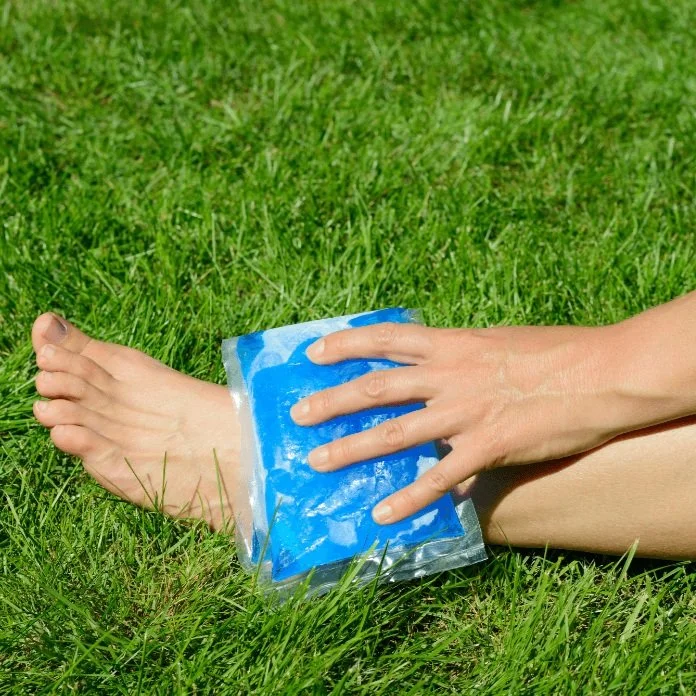
Tried and True Steps to Heal Ankle Pain and Knee Pain: The First 72 Hours
The first 72 hours after an injury like a strain or sprain are critical for healing. Here’s a simple guide to ensure you’re doing all the things during that time frame following the incident.
The first 72 hours after an injury like a strain or sprain are crititcal for healing. Here’s a simple guide to ensure you’re doing all the things during that time frame following the incident.
First of all, it’s always a good idea to get checked out by your health care provider to make sure no serious damage has occurred. If you have extreme pain or you think you may have broken a bone or torn something, see a doctor immediately!
But if you’re pretty sure it’s a sprain or strain, then follow these suggestions:
R = Rest
As soon as you’re hurt, stop your activity, and rest as much as possible for the first 2 days. The old “no pain, no gain” philosophy doesn’t work here. Pushing through the pain with certain injuries, like a moderate to severe ankle or knee sprain, can make the damage worse and delay your recovery. Doctors say you should avoid putting weight on the injured area for 24 to 48 hours. Resting also helps prevent further bruising.
I = Ice the area immediately!
I recommend crushed ice vs. a cold pack because you can cover more surface area and the cold lasts longer. Cover the injured area with ice in a bag for 20 minutes each hour.
After the first 24 hours, you can alternate between ice and heat, if you like. Ice reduces the swelling and helps with pain. Heat brings circulation to the area and sometimes feels good.
C = Compression
Wrap an ACE bandage around the injured area to compress it. Compression wrapping reduces the swelling and keeps blood moving more efficiently in the injured area. An ACE bandage is also helpful because it creates a layer of fabric between the ice and your skin, still making the ice effective.
E = Elevate
Elevate your injured body part heart-level or above if possible. You have have your leg on a chair if you’re sitting at work. Elevating an injured body part helps blood and fluid flow away from the injured area. This is helpful because it can help reduce swelling. Reducing your swelling can also decrease the inflammation and pain of your injury.

Use This 5 Minute Self Care Practice to Ground Yourself
Havening is a psychosensory technique that calms the nervous system and help you feel grounded, calm and peaceful.
Havening Technique® is a psychosensory technique that calms the nervous system and help you feel grounded, calm and peaceful.
Havening® is a technique facilitated by a certified practitioner, and can also be practiced at home as a self care practice to build resilience and soothe your nervous system. To learn more about self care practices, click here.
By slowly rubbing your hands together while either distracting yourself (I’ll explain this below) or imagining yourself in a peaceful setting, Delta waves, the slowest brain waves, are created. These Delta waves release oxytocin, dopamine, serotonin and GABA, the “happiness hormones,” and actually soothe and calm you emotionally, mentally and physically, in just 5-7 minutes.
Please note: if the feelings you’re experiencing are intense (above 3 on a scale of 1-10, 10 being highly triggered), I recommend you check with a qualified psychotherapist before trying this method or find a certified Havening Technique® practitioner, like myself, to assist you.
Time investment
5-7 minutes
Do this when
You feel stressed, anxious, overwhelmed, sad, grief, angry, need support
You want to expand and embody the feeling of calm, peace and love within yourself
You’d like to try Havening® as part of your regular self care practice
Benefits
Release of “happy hormones” (oxytocin, seratonin, dopamine and GABA) to calm and soothe
Regulate your nervous system (To learn more about your nervous system, click here.)
Feel more embodied
Sense of well-being
To set up you’ll need
A private space with a comfortable place to sit. Optional: a pillow on which you can rest your elbows.
Instructions
Begin to rub the palms of your hands together slowly, as if you were gently washing your hands
Breathe freely and naturally
If you’re feeling any distress (worried, sad, angry, fearful, etc.), begin to distract yourself as follows:
Count backwards slowly from 30-0 by 3s
Hum “Row Row Row Your Boat” 3X
Spell your first and last name backwards
List zoo animals for each letter of the alphabet. (Note: skip any letters if you can’t think of an animal. The answer isn’t important; you are engaging your brain in a certain way.)
Imagine yourself in your favorite place in nature. Based on what makes sense, observe what you see, hear, smell, feel, taste. (For example, imagine the sun on your face, the feeling of your feet in the sand, or the sounds of the waves lapping on the shore, the smell of seaweed.)
If you have trouble holding the visual image of yourself in nature, or find yourself feeling any emotional distress, then go back to steps #1-3.
Continue to haven continuously through all 4 steps. When you feel a sense of peace and calm, say the words out loud: “I am peace.” (or fill in the blank with a word that fits any good feeling you are able to authentically feel now).

Here's the Technique You Need to Calm Your Mind and Transform Your Emotional State
Havening is a psychosensory technique that calms the nervous system and can help you feel grounded, calm and peaceful.
Havening is NOT psychotherapy or talk therapy, and it is always recommended that you are working with a health care provider, especially if you are on medication. This is a form of somatic therapy and helps give relief on a subconscious level as well as providing you with tools for self soothing as a self care practice.
Havening is a psychosensory technique that calms the nervous system and can help you feel grounded, calm and peaceful. Psychosensory techniques are a form of therapeutic technique that use sensory stimuli to affect psychological and emotional health.
Dr. Ronald Ruden, a Harvard trained medical doctor who specializes in emotional trauma, neuroscience, and addictions, is the creator of Havening.
Over 30 years ago, he observed how, in most cases, a distressed infant is soothed quickly by gentle stroking on his back. Ruden researched the benefits of intentional touch on different areas of the body, concluding that when the upper arms, palms of the hands, and face are stroked gently and repeatedly, Delta waves are created in the body.
Delta brainwaves are the slowest brain waves, and they release oxytocin, dopamine, seratonin and GABA, also known as the “happiness hormones,” into the blood stream. These hormones are responsible for a neurochemical reaction that releases traumatically encoded memories that are stored in the amygdala, which leave a person feeling calmer, centered and resilient.
Havening uses sensory input in order to alter a thought, mood, or behavior. It’s believed that when you perceive an event or experience as traumatic or stressful, it becomes immutably encoded in your brain and body, often with life-changing consequences. Havening is designed to de-traumatize your nervous system by removing, altering, or diffusing the intensity of the emotional memory of your traumatic or stressful life event and its negative effects.
Havening is a somatic modality that is designed to help overcome problems caused by traumatic or stressful encoding, and it uses touch and the senses as its main tools.
In a session, a client has the opportunity to release the intense feelings around a traumatic event like an automobile accident or even a relationship or work-related situation — anything that has been disruptive and you feel its influence on your life in some uncomfortable way.
It also helps release familiar long standing emotions or behaviors such as constant fear, guilt, shame, worry or, for example, a familiar feeling like “waiting for the other shoe to drop” that have been with you ever since you can remember. Havening Technique® is designed to ease symptoms of chronic stress and anxiety. To learn more about what survival nervous system responses feel like, click here.
If you’d like to try self-havening at home, and feel the self-soothing effects of the “happiness hormones” for yourself, check out this blog post “Havening self care practice.”
Havening can benefit emotional stress in connection with:
Nervousness
Persistent worrying
Everyday stress
Feeling overwhelmed
Test anxiety
Fear about illness
Fear of heights
Afraid of the dark
Fear of flying
Fear of animals
Fear of abandonment
Fear of being out of control
Grieving
Caregiver support
Death of a loved one or pet
Letting go of past relationships
Abandonment
Physical or verbal assault
Childhood memories
Bullying
Traumatic accidents
Witnessing disturbing events
Relationships with parents, partners, bosses or colleagues, children
Anger, frustration
Guilt
Sadness
Shame, humiliation
Body image issues
Physical discomfort associated with stress
Sports performance enhancement
Emotional resilience and wellbeing