
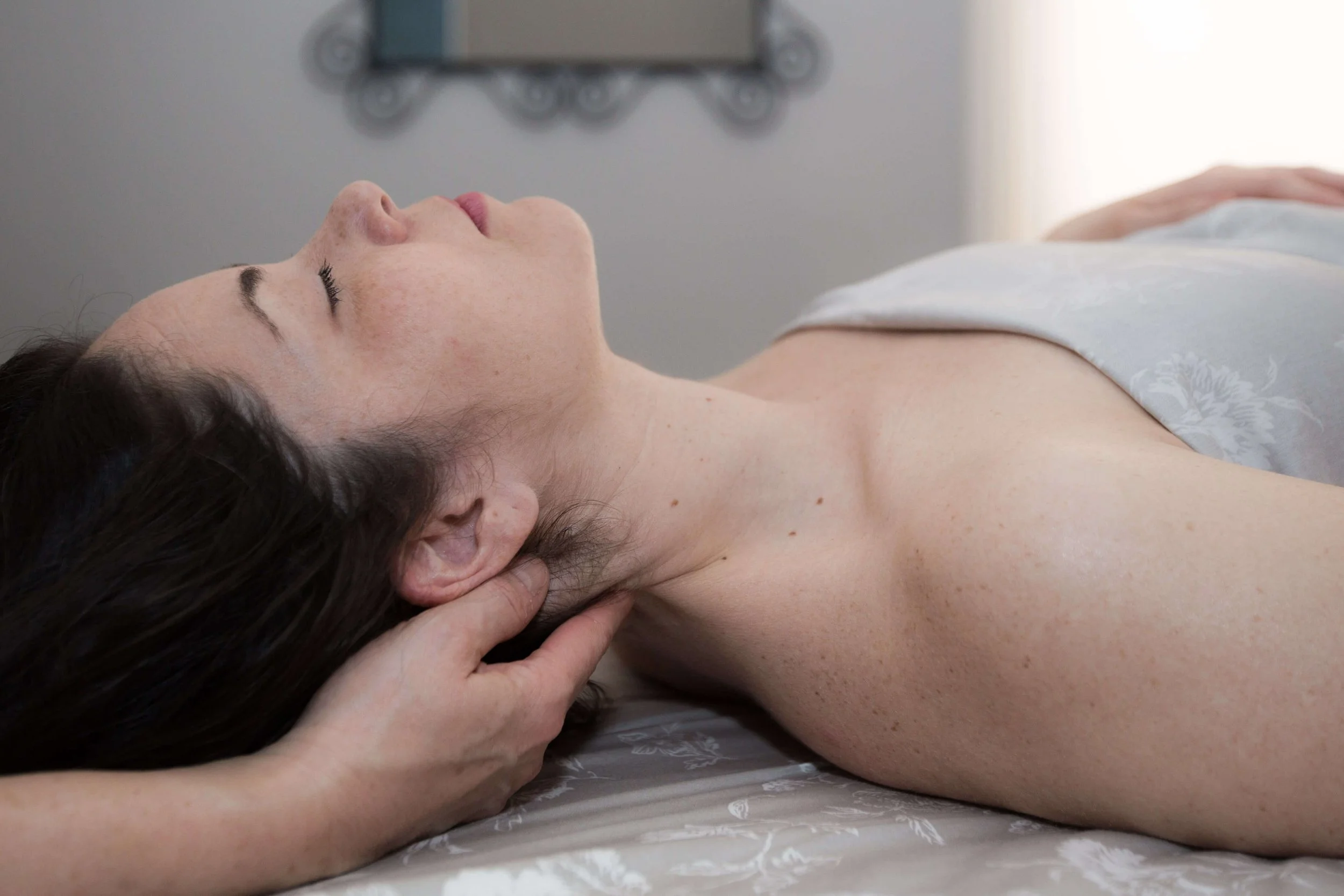
What to Expect in a Trauma-Informed Bodywork Session: How Touch Helps Heal Trauma and Regulate the Nervous System
When people ask me what trauma-informed bodywork looks like, I usually explain that it’s a gentle, hands-on approach that helps the body (and nervous system) find its way back to regulation and safety.
When people ask me what trauma-informed bodywork looks like, I usually explain that it’s a gentle, hands-on approach that helps the body (and nervous system) find its way back to regulation and safety.
Much of what I practice is inspired by the work of Kathy L. Kain, who integrates Ortho-Bionomy and somatic approaches, Dr. Peter Levine, the founder of Somatic Experiencing®, and Feldenkrais®, a method of somatic education. The basic idea is simple but profound: when the body feels regulated, our emotions and thoughts follow. We’re more grounded, less reactive, and better able to make healthy decisions.
What a Session Might Look Like
Sessions usually begin with a simple, supportive touch — for example, a steady contact at the small of your back while you remain fully clothed and comfortably lying on a treatment table.
This touch helps support the the adrenal glands, located just above the kidneys, and help regulate stress hormones like adrenaline and cortisol — key players in the body’s stress response. When these glands can “settle,” the body starts releasing long-held tension and stress hormones that may have been stuck in the system after prolonged periods of bracing or overwhelm.
When the adrenals are overworked, the body stays in a chronic fight-or-flight state. By helping them find balance, we remind the body how to access its parasympathetic response — the “rest and restore” mode — instead of constantly preparing for danger.
In practice, this might look like my hand resting quietly under your lower back for 10–15 minutes on one side, then the other. There’s no manipulation or movement — just gentle, steady contact that gives your system space to unwind at its own pace. I’ll often check in to see what you’re noticing, since this work is more of a collaborative process than something I do to you.
Deeper Layers of Regulation
Once your adrenal system begins to regulate over time (which can take several sessions depending on your history, nervous system and physiology), we can explore other forms of trauma-informed touch.
For example:
Brain stem holds can calm the nervous system and restore a sense of safety.
Fascia work helps release tension in the connective tissue just under the skin — a place where emotion and stress are often stored.
When fascia is tight or “activated,” it can contribute to feelings of agitation, anxiety, or even physical sensations like chest pressure or a creeping sense of fear. The mediastinum fascia, which wraps around the heart and lungs, is especially sensitive — calming this area can bring a deep sense of ease and spaciousness to the breath and chest.
Viscera work supports trauma healing by gently engaging the organs — where deep-seated “gut reactions” and stress responses often live. By helping the viscera release stored tension, this work can improve emotional regulation, support healthy organ function, and allow for a greater sense of presence and ease in the body.
Releasing Protective Patterns
Many of us live in bodies that are unconsciously bracing — jaw tight, shoulders rounded, chest tense, breath shallow. These are protective patterns that once helped us survive but now keep us stuck in chronic tension.
To support release, I often integrate movement-based approaches like the Feldenkrais Method® or Biodynamic Craniosacral Therapy. These gentle methods help the nervous system recognize safety through movement and awareness, softening patterns of holding and protection.
Feldenkrais helps your body unlearn old tension patterns that formed in response to stress or protection. As the nervous system discovers new options for movement, a natural sense of stability and calm begins to emerge.
Craniosacral Therapy uses light, attuned touch to help the body unwind from stress and trauma. From a trauma-informed lens, it helps the nervous system feel safe enough to release old patterns and return to a natural state of ease.
Why It Works
By working directly with the body, trauma-informed touch helps regulate the nervous system faster than talk alone. Once your body feels calmer and safer, talk therapy (if part of your process) becomes much more effective — because the body and mind are finally speaking the same language.

Physical Symptoms of Anxiety and Hyper-Vigilance
From a somatic, or body perspective, anxiety refers to the sensations generated by the body’s total response to a threat. Our body reacts to this threat because it will do anything to survive. When we remain in a constant state of hypervigilance, we experience predictable bracing and contracting patterns throughout our system.
From a somatic, or body perspective, anxiety refers to the “sensations generated by the body’s total response to a threat.” The body reacts to this threat because it will do anything to survive.
Physiological symptoms of anxiety and being in a hypervigilant state include:
Chronic muscle pain (back, neck, shoulders, hips, pelvis, etc.)
Heart palpitations or irregular heart beat
Holding breath, shallow breathing or shortness of breath
Migraines and headaches
Contraction in throat, chest, belly
Digestive issues (constipation or loose bowels diarrhea, etc.)
Sleep issues, insomnia
Fibromyalgia
Sweating, especially palms of hands or soles of feet
Heat or shivering
Dizziness, light-headedness
Pins and needles
Trembling, shaking, twitching
Feeling weak or tired
A churning feeling in your stomach
Nauseau
Feeling restless or irritable
Difficulty concentrating
Grinding teeth or pressing tongue into backs of teeth
Do any of these physical symptoms sound familiar? If so, the good news is it’s not a bunch of different problems — it’s all one thing: a dys-regulated nervous system, very possibly like this for many years, and possibly your body’s way of managing a fight or flight charge that was never released at the time of one or many traumatic events — either recent or from many years ago.
THE AMYGDALA’S ROLE IN ANXIETY
Some people find psychotherapy helpful, but often people report there’s no real change in their physical symptoms of anxiety from talking — also referred to as a “top-down” approach.
One reason for the inability to feel physical relief is that the amygdala, the part of the brain that is scanning for danger because it’s wired for us to survive, continues to fire and send signals to the body to be vigilant. So the body continues to “brace” and “contract” in anticipation for the next bad thing to happen. The rational thinking part of the brain can’t come online until the more primitive, survival part of the brain calms down.
The amygdala doesn’t listen to reason, it acts to keep you safe.
When the amygdala, the part of the limbic system that protects us, perceives a threat, it triggers a fear or anxiety response that activates the body's fight-or-flight system. This response can include increased heart rate and blood pressure, feelings of fear and anxiety, and increased stress hormone levels, and any of the symptoms listed above.
We can’t control our physiology with the thinking (rational) part of our brain. We can’t reason ourselves out of a burst of cortisol or rapid heart rate.
But we can use the sensory part of our brain to regulate our physiology.
BOTTOM UP APPROACHES TO REGULATE THE NERVOUS SYSTEM AND REDUCE PHYSICAL SYMPTOMS OF ANXIETY
This is where “bottom up” approaches such as trauma-informed somatic techniques and trauma-informed bodywork are effective in changing the physiology of anxiety and regulating the nervous system.
Some of these techniques include: Somatic Experiencing®, The Feldenkrais Method®, Havening Technique®, and Craniosacral therapy.
The goal is not only to simply feel calmer for the moment and then fall back into anxiety, but to learn how to regulate nervous system physiology and create new, healthier neural pathways (also known as neural “habits”) that begin to overtake the older, habitual neural pathways of anxiety.
Neural pathways are simply the connections that form between the neurons, or brain cells, in your brain.
Somatic Experiencing® and Feldenkrais® work with the process of neuroplasticity. Neuroplasticity is the ability of the brain to change and reorganize and to create new neuralpathways.
With these somatic methods, you actually change nervous system “habits,” but instead of doing this from the top down (i.e., mind over matter or forcing oneself to be or think a certain way) it’s done with a bottom up approach, which means including one’s body in the equation and following and listening with one’s focused attention to the sensations of the body to guide the process.
Movement as a common pathway in the body
Feldenkrais uses focused attention and slow, gentle, small movements to access this inherent plasticity of the brain.
Movement is the common pathway to all of our body systems: respiratory system, nervous system, muscular system, cardiovascular system, digestive system, urinary system, endocrine system, lymphatic system.
Our nervous system keeps us safe by knowing when to move toward, move away from, stay still to conserve energy, and so on.
The nervous system processes as a very slow pace. In Feldenkrais, we move slowly to match the pace of the nervous system. We make small movements to create a non-threatening environment for the brain so that it can signal muscles to release.
To read more about how Feldenkrais works with neuralplasticity, link here.
The reason for the nervous system is movement.
Fast movements heighten the sympathetic activity (fight and flight) and slow movements allow the nervous system to be in a parasympathetic state (rest and digest).
In Feldenkrais we move slowly to allow the brain to access this parasympathetic state.
When you’re in chronic pain or experiencing other physical symptoms of anxiety, your thinking brain is off line and the brain is noisy. The brain believes there’s a threat that’s emminent.
Feldenkrais provide alternatives to what has been the status quo of anxiety.
When working within the framework of Somatic Experiencing®, this trauma informed bodywork can create an experience of safety, grounding and resourcing so that people can begin to work with the unprocessed trauma through the wisdom of their body.

Having Lower Back Pain? Here Are 7 Ways to Check If You Have Good Posture When Sitting
There are a number of myths surrounding the concept of “good posture” and it’s especially important to recognize these myths when sitting.
There are a number of myths surrounding the concept of “good posture” and it’s especially important to recognize these myths when sitting.
For example, “good posture” doesn’t mean being planted in your work chair in a fixed, upright position, holding in your abdomen and pulling your shoulders down and back.
Good or healthy posture means sitting in a way that allows freedom of movement of your entire body in any direction, as needed.
Try this.
Without changing anything about your posture, observe whether you can:
1. Turn your head to the right and left?
2. Turn your head and torso (shoulders and ribcage) to the right and left?
3. Can you breath freely into both your chest and abdomen?
If you’re engaging your abdominal muscles, you cannot breathe easily. In fact, when your abdomen is engaged, your diaphragm is drawn in and up, and your entire ribcage and back will be rigid and not able to move freely.
Your skeleton, and not your muscles, should do the primary work of holding you upright.
In order to see if you’re using your skeleton to support you in sitting, check:
1. Are both of your feet flat on the floor?
2. Are you sitting evenly on both sides of your bottom?
Sitting asymmetrically on one side can cause strain. (Some men already know this and remove their wallets from their back pocket when sitting!) When the weight of the body is distributed evenly over both sitting bones, your back doesn't have to work as hard.
3. Is your lower back rounded or slightly arched?
A slightly arched lower back offers better support and reduces pressure on the discs.
4. Are you leaning back in your chair or sitting forward in your seat?
Most people slump and round onto the back of their pelvis when leaning back. This causes muscular stiffness and strain. If you must lean back, place a pillow behind the small of your back so that a healthy arch is maintained.
For more information about sitting dynamically on your pelvis to prevent back, shoulder and neck pain, see my blog post called “Here's the Right Way to Sit in a Chair to Relieve Lower Back Pain”
If you’d like to experience more mobility in your pelvis so that you your back, neck and shoulder muscles are no longer responsible for holding you up in gravity, check out this recording of “Sit Like a Pro,” a recording of a short workshop that teaches you the tools that will give you comfort and ease when sitting.

How to Balance Your Nervous System with Biodynamic Craniosacral Therapy
Biodynamic Craniosacral Therapy is a gentle, non-invasive hands-on treatment for the whole body where the practitioner listens to the system through her hands for any patterns of inertia or congestion.
You can get a massage for your body, but can you get a massage for your nervous system?
Biodynamic Craniosacral Therapy is a gentle, non-invasive hands-on treatment for the whole body where the practitioner listens to the system through her hands for any patterns of inertia or congestion. The treatment is focused on supporting the health of the whole being, in particular the nervous system -- that system of the body that dictates all the functioning.
CST helps to relieve stress, tension and physical discomfort and brings the body back into balance. It supports the body’s innate ability to balance, restore and heal itself, as well as reduce stress. During or after a treatment, clients report feelings of calmness and often increased energy, with renewed clarity of mind and a feeling of well-being.
This type of therapy can stand by itself, but I love how it works alongside massage, which has it’s own set of physical, mental and emotional benefits. And because it is so gentle and non-invasive, crasniosacral therapy is suitable for everyone, including pregnant mothers and newborns. In fact, many midwives and doctors recommend craniosacral therapy during pregnancy because it calms the nervous system of both mother and child. When Mom's system is soothed and balanced during pregnancy, baby gains huge benefits.
Craniosacral therapy with massage is like receiving a massage on the inside and out!
Did you enjoy this post?
Make sure you sign up for our newsletter below to get other tips sent to your inbox.

Why It's Easy to Fall Asleep During Biodynamic Craniosacral Therapy
It is common for people to doze off or at least appear to sleep during portions of a craniosacral session. There are times when a deep, meditative state of consciousness is contacted, when the mind gets out of the way to allow the system to reorganize in some profound way.
It is common for people to doze off or at least appear to sleep during portions of a craniosacral session. There are times when a deep, meditative state of consciousness is contacted, when the mind gets out of the way to allow the system to reorganize in some profound way. If your system is tired, you’ll relax and rest, which is deeply healing in itself.
Did you enjoy this post?
Make sure you sign up for our newsletter below to get other tips sent to your inbox.

How Can I Benefit From Biodynamic Craniosacral Therapy?
The therapy may surprise you with benefits you hadn't known were possible, including resolution of symptoms that you had no idea were related to the cranial system or to each other. You may feel lighter, with a sense of more spaciousness within yourself.
The therapy may surprise you with benefits you hadn't known were possible, including resolution of symptoms that you had no idea were related to the cranial system or to each other. You may feel lighter, with a sense of more spaciousness within yourself. You may notice more ease in relationships or ability to focus. You may stand straighter or breathe more easily and deeply. Pains may decrease and emotional boundaries may be easier to maintain. It is likely that you will feel deeply relaxed and centered.
From Biodynamic Craniosacral Association of North America (www.craniosacraltherapy.org)
Did you enjoy this post?
Make sure you sign up for our newsletter below to get other tips sent to your inbox.